Myth:
We can’t possibly know what temperatures were like centuries ago, let alone millions of years ago. They might actually have been hotter during the Medieval Warm Period (900-1150 AD) than now, so we can’t say the Earth is heating up unnaturally.
Fact:
Scientists use ‘proxies’ to calculate past temperatures. These include tree rings, ice cores, coral sediments and sea levels. [The study of past climates is called paleoclimatology.] The data produced by these proxies is not perfectly accurate but does provide a good picture of the past. That data suggests that the Medieval Warm Period was not warmer than today, although temperatures may have been this warm in parts of the northern hemisphere. [Interestingly, climate sceptics are happy to use evidence from proxies when they confirm their views, but not when they contradict them.] For more detail on the Medieval Warm Period, see the previous two myths.
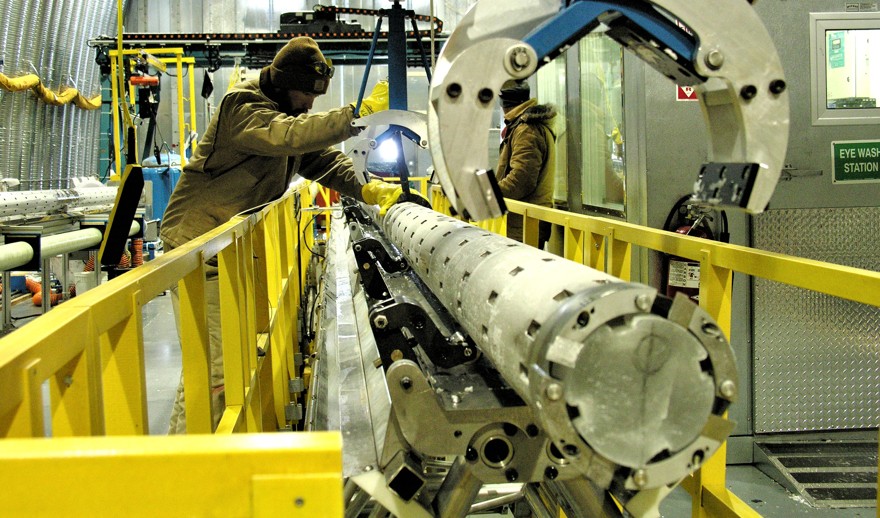
An ice core drill – part of the took kit used by paleoclimatologists. [Source: Wikimedia Commons]
Sources:
Valerie Masson-Delmotte et al, “Temperature Variations During the Last 2000 Years,” Climate Change 2021: The Physical Science Basis. Contribution of Working Group I to the Sixth Assessment Report of the Intergovernmental Panel on Climate, Cambridge University Press, 2013
“Paleoclimatology,” US National Oceanic and Atmospheric Administration. https://www.ncei.noaa.gov/products/paleoclimatology
“Paleoclimatology,” National Geographic Society. https://education.nationalgeographic.org/resource/paleoclimatology-RL/