
Myth:
Phasing out Australia’s fossil fuel exports would deny the country billions of dollars of foreign income and cause its exchange rate to collapse.
Fact:
It’s true that the elimination of fossil fuel exports on its own would have very negative impacts on the economy, as about 7 percent of our GDP is derived from this source. However, the Commonwealth Treasury estimates that revenue from such exports is set to nosedive over the next two decades – from A$198 billion in 2025 to A$106 billion in 2030 and A$46 billion in 2050. By contrast, exports of products related to clean energy – like ammonia, iron, steel, bauxite, alumina, aluminium, copper, lithium, nickel and cobalt are expected to rise from about A$46 billion in 2025 to A$120 billion in 2035 and A$270 billion in 2050. In fact, they are set to bring in far more income and foreign exchange than fossil fuels do today.
In addition, the switch to EVs will save us from importing $40 billion a year of petroleum and diesel to run our vehicle fleet. An added advantage is that we will no longer have to worry about having our energy supplies cut off in the event of a regional conflict, like the one between Iran, Israel and the United States. And, of course, there is always the awkward fact that our fossil fuel exports are going to decline and ultimately collapse anyway, since our trading partners are all committed to net zero emissions and energy self-sufficiency.
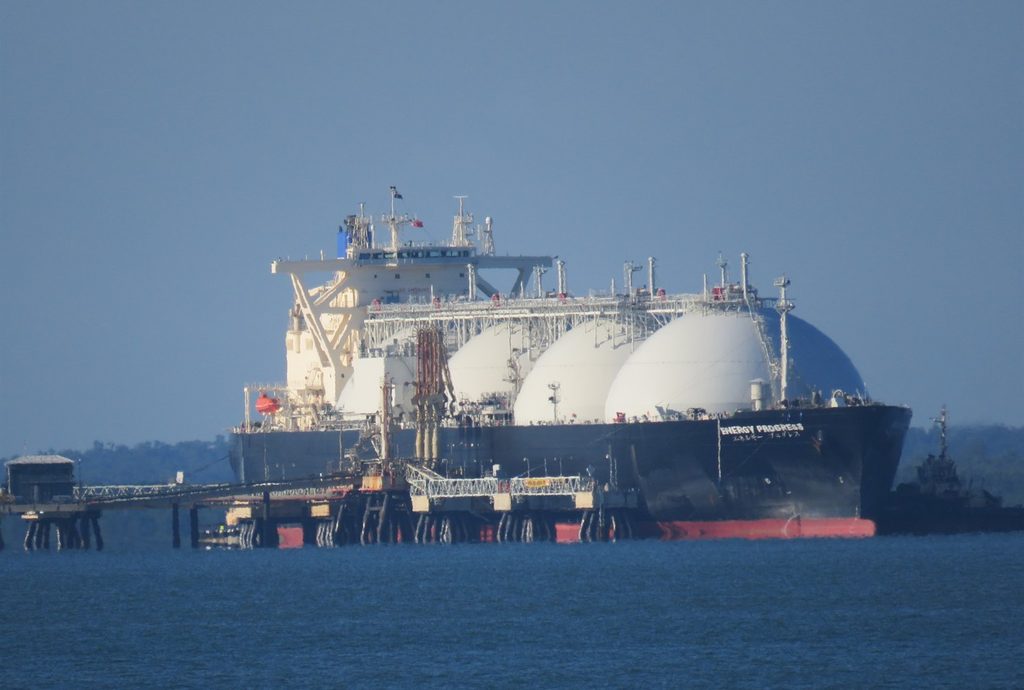
An LNG tanker loading up in Darwin, in Australia’s north. [Wikimedia Commons]
Sources:
Graham Readfearn, “Value of Australia’s coal and gas exports will plunge 50% in five years, treasury modelling forecasts,” The Guardian, 20/9/25
Michael Barnard, “When Asia says no to LNG: The shrinking markets that could leave Australian cargoes stranded,” Renew Economy, 25/9/25
David Leitch, “Australia is not alone in embracing wind and solar, and we are certainly not way out front,” Renew Economy, 25/9/25
“New CEF report: China’s $120bn investment blitz into global critical minerals leaves Australia exposed,” Climate Energy Finance Newsletter, 26/3/26