
Myth:
If the Earth was warming, why did the amount of sea ice in the Antarctic increase rather than decrease between 1979 and 2014?
Fact:
It is true that Antarctic sea ice did increase by about 3.5 percent between 1979 and 2014, but it began shrinking again in 2015 and has now reached the lowest level ever recorded. [We don’t have figures for before 1979, as this was when satellite monitoring began.]
One reason for the rise in sea ice levels prior to 2014 is that the winds that blow off the continent increased, carrying more cold air out to sea, where ice forms. Another reason is that increasing meltwater from the Antarctic ice sheets led to an increase in ice formation, as fresh water freezes at a higher temperature (0°C) than salt water (-2°C). Finally, higher temperatures increased the amount of snowfall over both the continent and the surrounding oceans, thereby increasing sea ice cover. [This is because warmer air holds more moisture.]
The problem, however, is not the loss of sea ice in Antarctica but the loss of land ice. Between 2002 and 2025, that loss averaged 135 billion tonnes a year, causing sea levels to rise by 0.4 millimetres per year. The science suggests that the rate of loss is only going to increase as the Earth’s atmosphere heats up. [It takes approximately 360 billion tonnes of ice to produce one millimetre of global sea-level rise.]
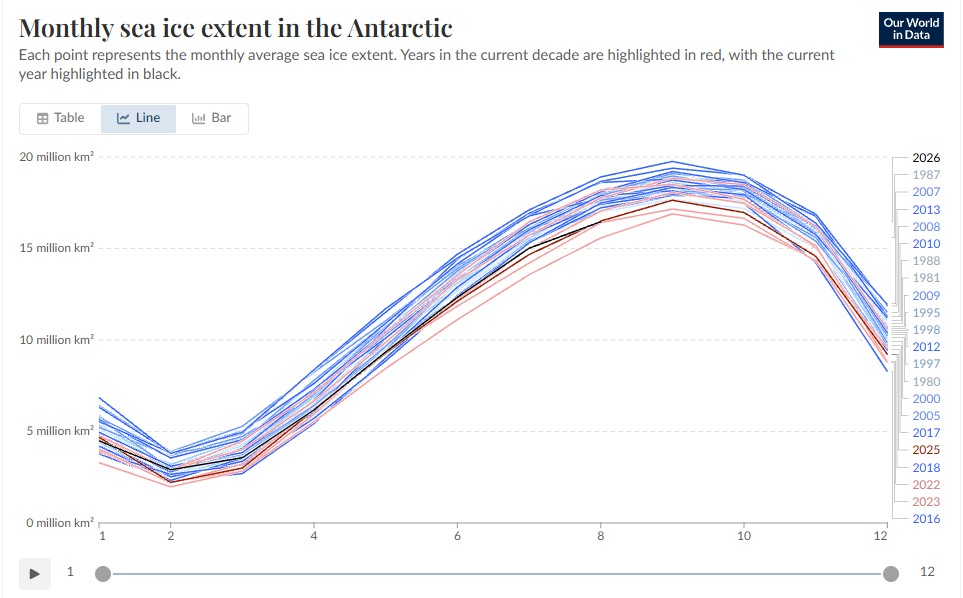
The graph shows the amount of sea ice in the Antarctic by month, since 1987. The horizontal bar shows the months, starting with January (number 1). The vertical bar shows the amount of ice. As expected, there is more ice in winter than in summer (winter being in the middle of the year in the southern hemisphere). The lines in red show the amount of ice this decade. As can be seen, that amount has reduced significantly over the past four decades. [Source: Our World in Data]
Sources:
Lisa Cox, “Mass melting of Antarctic ice sheet led to three metre sea level rise 120,000 years ago,” The Guardian, 13/2/20
Oliver Milman, “Global heating pace risks ‘unstoppable’ sea level rise as Antarctic ice sheet melts,” The Guardian, 6/5/21
Angela Fritz, “‘Doomsday glacier’, which could raise sea level by several feet, is holding on ‘by its fingernails’, scientists say,” CNN, 5/9/22
Graham Readfearn, “Antarctica warming much faster than models predicted in ‘deeply concerning” sign for sea levels,” The Guardian, 8/9/23
Adam Morton and Graham Readfearn, “Red alert in Antarctica: the year rapid, dramatic change hit climate scientists like a ‘punch in the guts’,” The Guardian, 31/12/23
Laura Paddison, “Scientists looked deep beneath the Doomsday Glacier. What they found spells potential disaster for the planet,” CNN, 20/9/24
Jano Gibson, “Antarctic sea ice falls to near-record low as study reveals ‘structural change’,” ABC News, 6/3/25
Jano Gibson, “Antarctic sea ice falls to near-record low as study reveals ‘structural change’,” ABC News, 6/3/25