
Myth:
The disposal of solar panels and batteries make them an uneconomic and dangerous proposition.
Fact:
Solar panels are easy to recycle, as they are 76 percent glass, 10 percent plastic, 8 percent aluminium, 5 percent silicon and 1 percent copper. Other metals make up just 0.1 percent of the total.
A lithium Iron Phosphate (LNP) battery is 15-20 percent iron, 12-15 percent phosphorus, 10-15 percent carbon, 5-10 percent aluminium, 5-10 percent copper and 3-4 percent lithium. The rest of the battery is made up of plastics and electrolytes. All of these minerals and polymers can be recycled.
As for the economics of disposal, the cost of having a solar panel recycled in Australia is about $20 (US$14). [It cost the author $18.94 to have each of his 12 old solar panels recycled in 2026.] The cost of recycling a home battery is between $300 and $500 – or about the same as recycling 20 solar panels. In addition, it is estimated that the global value of recyclable materials from solar PV panels will be $US2.7 billion a year by 2030 and a $US80 billion a year by 2050.
That said, it’s always easier to dispose of panels and batteries by putting them in landfill, so tough government legislation is required in order to prevent this from happening.
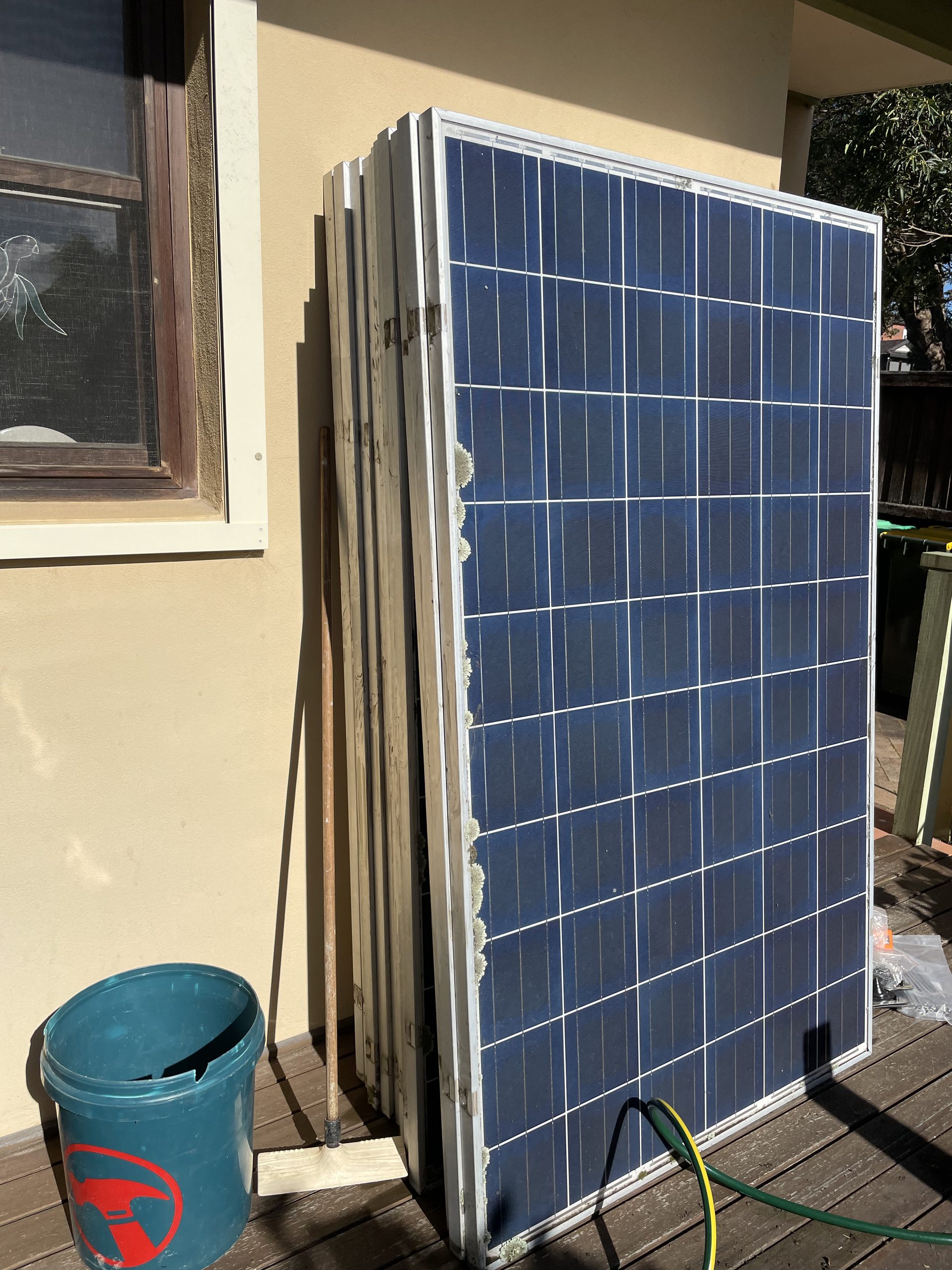
The author’s old solar panels, waiting to be taken away for recycling. The total cost was A$227.27, or A$18.94 per panel. [Source: Ken Enderby]
Sources:
Solar panels:
Mahdokht Shaibani, “Solar panel recycling: Turning ticking time bombs into opportunities,” PV Magazine, 27/5/20
Joshua S. Hill, “Solar panel recycling market to be worth billions by 2030, say researchers,” Renew Economy, 7/7/22
Jacinta Bowler, “New solar panel recycling process recovers 99 pct of silver from cells,” Renew Economy, 20/7/23
“Recycling the future: sustainable solutions for renewable energy technologies,” Clean Energy Council, 8/8/25. https://cleanenergycouncil.org.au/for-consumers/fact-sheets/recycling-get-the-facts/recyling-wind-turbines-solar-panels-batteries
Batteries:
“Lithium-ion battery recycling,” CSIRO. https://www.csiro.au/en/research/technology-space/energy/decarbonising-industry-transport/energy-in-the-circular-economy/battery-recycling
“Lithium-Ion Battery Recycling,” United States Environmental Protection Agency. https://www.epa.gov/hw/lithium-ion-battery-recycling
“How are Lithium-Ion Batteries Recycled?” Aqua Metals. https://www.aquametals.com/recyclopedia/how-are-lithium-ion-batteries-recycled/
Jacinta Bowler, “Australian battery recycling start-up given $8 million to scale tech,” Renew Economy, 5/10/23
“How Are Lithium Batteries Recycled, and Why Is It Important?” Ecoflow, 30/7/25. https://energy.ecoflow.com/uk/blog/how-are-lithium-batteries-recycled